
Prospecting is hard. Generic sales decks get bored nods. Case studies from other industries don't always land. But showing up to a prospect meeting already armed with opportunities is a different kind of pitch entirely.
A targeted mini-audit is one of the most effective new business tools an SEO agency can have. It's even better if you arrive with findings before you've been hired to do anything. It demonstrates expertise without claiming it. It opens conversations that would otherwise go nowhere. And it creates a natural path from "here's what we found" to "here's what a full engagement would look like."
And don't think for one second that you're giving away your work. As with good pitches, you're investing a bit of time up front to earn the right to a real conversation.
Why the Prospecting Audit Works
Most agency outreach leads with the agency: Here's our team, here's our process, here's a client we helped in your industry. That's all fine, but it puts the burden on the prospect to imagine what you'd do for them specifically.
A mini-audit flips that. You've already looked at their site. You already know something they probably don't. That changes the dynamic from "let us tell you about ourselves" to "let us show you what we already noticed about you."
The credibility signal is immediate. If you found three meaningful issues in 30 minutes without being paid, the implication is clear: a full engagement would go much deeper. You don't have to say that. They'll think it.
It also self-selects for better prospects. Sites with real SEO problems show up in a mini-audit, and these are the ones that would actually benefit from your help. Sites that are already in good shape surface fewer issues, which might tell you something about how much room there is to add value.
Choosing Who to Audit
You can't audit every prospect. The goal is to spend 20–30 minutes per site on businesses where there's a realistic fit. Do enough of them so that some percentage of those turn into conversations.
Good candidates tend to share a few traits:
- Active organic search presence but obvious gaps: They're showing up in search for some things but missing obvious opportunities. You can often spot this quickly with a keyword tool before you even crawl the site.
- A site that looks recently redesigned: Redesigns are high-risk SEO events. New platforms, new URL structures, and new templates frequently introduce technical problems — and clients who just relaunched are often unaware of what broke in the process.
- Competitors outranking them visibly: If you can show a prospect that their direct competitor is ranking #1 for a term they're not even on page one for, and you can tie it to something auditable, that's a conversation starter.
- A business size where SEO ROI makes sense: A mini-audit is most worth your time when the prospect could realistically become a client. Make sure the size, industry, and budget profile fit before you invest the time.
What to Audit (Without Burning Hours)
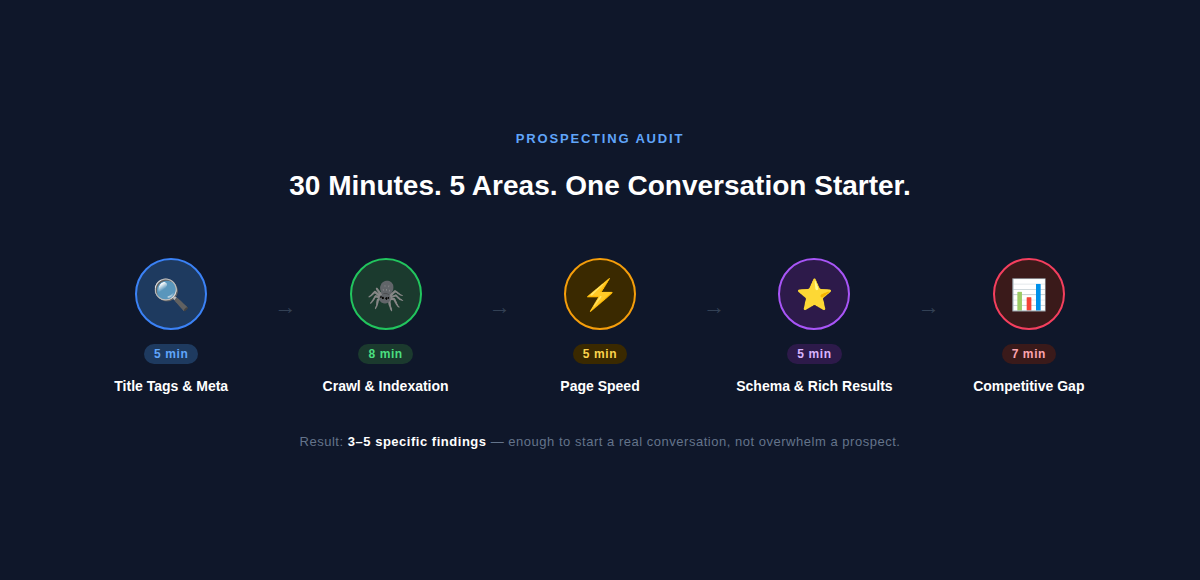
A prospecting audit is not a comprehensive crawl. You're looking for visible, high-impact problems that are fast to find and easy to explain. Stick to a defined checklist and a hard time limit.
Title Tags and Meta Descriptions
These are quick to pull and easy to explain to a non-technical stakeholder. Look for:
- Missing or duplicate title tags
- Titles that are truncated in SERPs (over 60 characters)
- Generic or templated titles that don't reflect what the page is actually about
- Homepage titles that lead with the brand name rather than a keyword-forward description
A prospect seeing their own homepage title cut off in a Google result understands the problem immediately. No jargon required.
Crawl and Indexation Issues
A quick crawl will surface 404s, redirect chains, and pages blocked from indexing. You don't need to enumerate every broken link — you need to find whether important pages are affected.
Check specifically:
- Are key landing pages or product pages returning errors?
- Is the site's robots.txt accidentally blocking anything it shouldn't?
- Are there redirect chains of three or more hops on pages with significant traffic?
One broken redirect on a high-traffic page is worth more in a prospecting conversation than a hundred broken image links on obscure pages.
Page Speed
Run their primary landing pages through PageSpeed Insights. Mobile scores below 50 are easy to explain and hard to dismiss. Load time issues on a homepage or key conversion page are the kind of problem that resonates with business owners who've never thought about technical SEO — slow pages cost sales, and they can feel that.
Missed Schema Opportunities
Pull up a few of their target search terms and look at what's appearing in the SERPs. Are competitors showing star ratings, FAQs, or other rich results that the prospect isn't? A screenshot of a competitor's rich result next to the prospect's plain listing is a visual that lands in a sales conversation.
A Quick Competitive Benchmark
You don't need to run a full competitor analysis, but a quick look at how the prospect ranks versus two or three direct competitors on their core terms gives you a "here's where you stand" moment. Gap analysis is something almost every business stakeholder can engage with — the question of why a competitor is outranking them is one they've often already asked themselves.
How to Package and Deliver the Findings
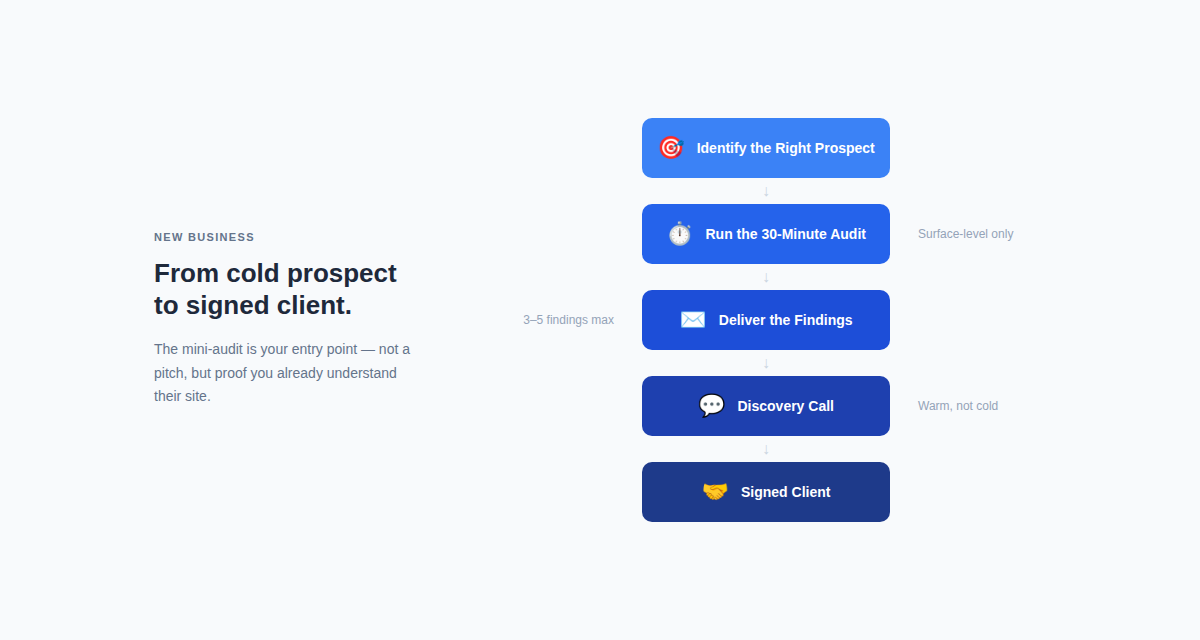
Keep it short. Make it three to five findings, not fifty. A 20-page audit report that's sent cold will not be read. A one-page summary of specific, high-impact issues—with clear explanations of what each one means for their business—will.
Format options:
- A brief PDF or slide: Clean, branded, easy to forward internally. Good for companies where your contact isn't the decision-maker and needs to share it up the chain.
- A Loom video walkthrough: This is both easy and surprisingly effective. A 3–5 minute screen-share where you walk through the issues feels personal and shows your thinking in real time. It's harder to ignore than a document.
- A direct email with findings inline: Works well for smaller businesses or when your contact is the owner. Gets to the point fast and doesn't require them to open an attachment.
Whatever format you use, lead with the business impact, not the technical issue.
Not "you have 14 redirect chains" but "three of your highest-traffic pages are losing link equity because of redirect chains, which means the rankings those pages should have are lower than they could be."
This is one of my favorite points about presenting a site audit to a (potential) client:
The technical detail is the evidence; the business impact is the reason they should care.
Handling the Objections
A few pushbacks come up regularly when you lead with a prospecting audit. It's worth having responses ready.
"Are you just looking for problems so you can sell me something?"
This is fair, and the honest answer is: yes, you're hoping to start a conversation about working together, but you're only reaching out because you found real issues worth discussing. If the site were in great shape, you wouldn't be emailing them. That's not a pitch; it's just true.
"Our current agency handles this."
Acknowledge it. Then ask: are the issues you found things they've flagged before? If they have and nothing's been done, that's a conversation about prioritization. If they haven't, that's a different conversation. You're not attacking the current agency — you're asking a question.
"We don't have budget for SEO right now."
Budget constraints are real, but they're also sometimes cover for "we don't see the value yet." If your findings are compelling — especially if you can connect them to traffic or revenue they're likely leaving on the table — this objection often softens. You can also propose a scoped, lower-commitment starting point rather than a full engagement.
Converting the Conversation
The goal of the prospecting audit isn't to close a deal in the first email. It's to earn a conversation. Once you're in that conversation, the transition is natural.
What you found in 30 minutes is the surface. A full audit would tell them the scope of the problem, the prioritized fixes, and the projected impact. That's the proposal. You're not pitching blind — you're recommending a specific next step based on evidence you've already put in front of them.
One framing that works well: "What we did here was a quick scan, not a full audit. We found enough to know there's real work to do. A complete engagement would take this from 'here are some issues we spotted' to 'here's your full prioritized roadmap with implementation support.'"
That's the difference between a cold pitch and a warm handoff to a proposal.
Making It a System, Not a One-Off
A single prospecting audit is a tactic. Done consistently, it becomes a business development channel.
A few ways to systematize it:
- Set a weekly cadence: Audit two or three prospects per week. At even a modest conversion rate, that compounds over time.
- Templatize your checklist: Build a repeatable 30-minute audit process so the time investment stays fixed regardless of site size.
- Templatize your outreach: Personalize the findings, but standardize the framing and delivery format so you're not starting from scratch every time.
- Track your hit rate: Which industries respond? Which issue types generate the most replies? Over time you'll develop a profile of the prospect type most likely to convert from audit to engagement.
The agencies that do this well treat the prospecting audit not as a favor they're doing prospects, but as a deliberate top-of-funnel activity with a measurable conversion rate. That shift in framing changes how consistently it gets done.
An audit delivered to a paying client shows what you can find. An audit delivered to a prospect before they've committed to anything shows why they should hire you. Those are two different use cases for the same skill — and the second one is underused by most agencies.
