
"Did traffic go up?" For years, that was the only SEO question that mattered. Rankings led to clicks, clicks led to sessions, and sessions meant the strategy was working. Neat, linear, and mostly obsolete.
Google processes 3.5 billion searches every day. And over half of U.S. Google searches now end without anyone clicking anything. Featured snippets, AI Overviews, and knowledge panels hand users the answer before they ever reach your site. Your content does the work, but your analytics take no credit.
If you're still reporting SEO performance purely through traffic, you're not measuring what SEO actually does anymore. Let’s dive in and learn what to track instead.
Zero-click searches are the new normal
Zero-click search is when a user gets their answer directly on the results page, through a featured snippet, AI Overview, knowledge panel, or People Also Ask box, without ever clicking through to a website. It's now the dominant search behavior in the U.S.
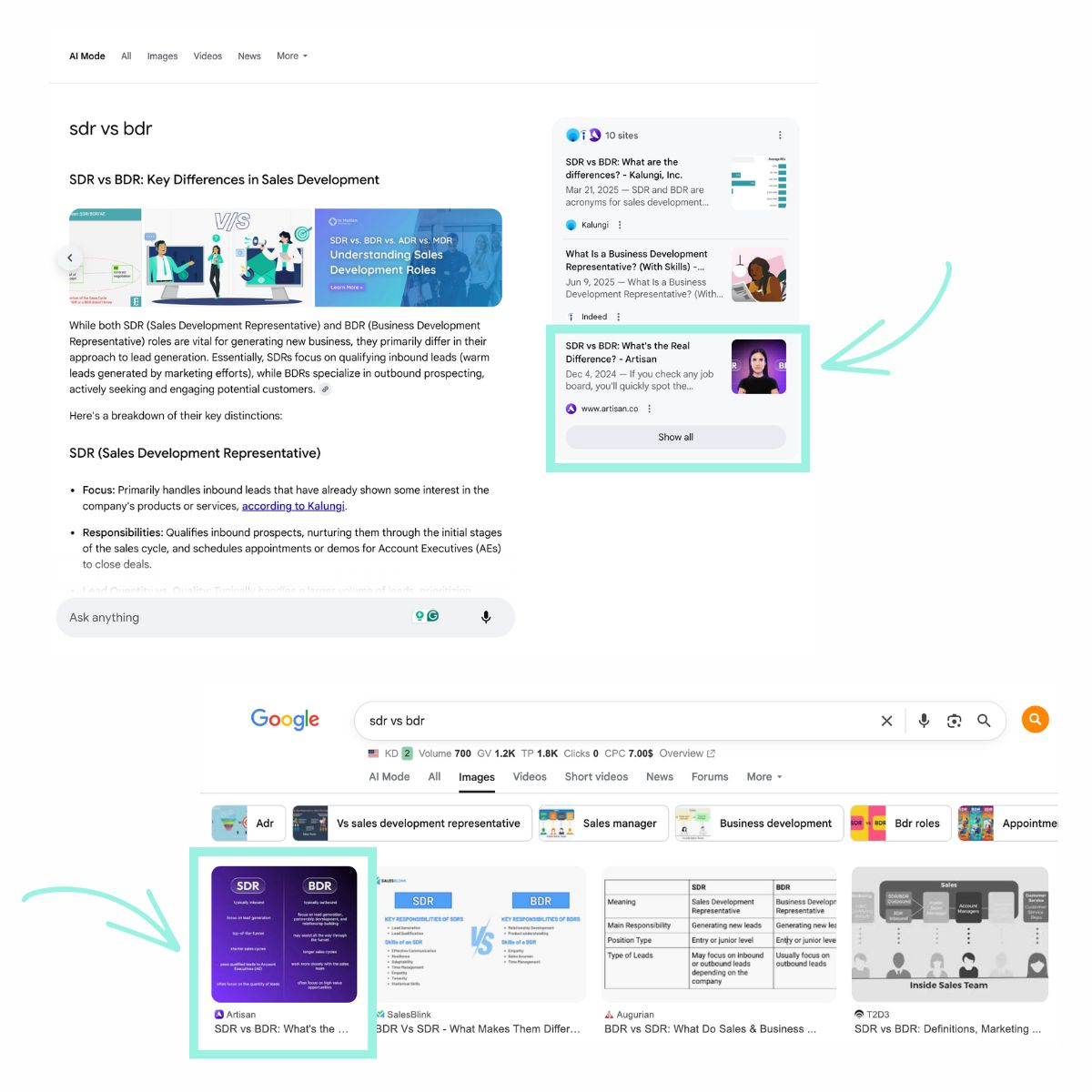
Take this “SDR vs BDR” article. Artisan is not ranking #1 on SERP, but they are still showing up on Google images, first-page image snippets, and AI Mode.
Source: Irina Maltseva’s LinkedIn
And no, this isn't something Google invented last year. Google has been nudging users toward on-SERP answers since featured snippets launched in 2014. What's changed is the scale. AI Overviews now appear in roughly 25% of queries, and on mobile, where most searches happen, the zero-click rate sits at 75%. AI Overviews now appear in roughly 30% of queries, and on mobile, where most searches happen, the zero-click rate hits 77%.
When organic traffic drops, AI Overviews get blamed first. It's an easy target. But the full picture is messier, and if you only fix half the problem, you'll keep chasing your tail.
User behavior is pulling in the same direction. People want faster answers. If a SERP tells you the capital of France or explains what a churn rate is, you don't need to open four tabs anymore to confirm it. The answer is already there.
Here's the reframe that took me a while to internalize: a zero-click result isn't a failure.
If your blog page, videos, or infographics is the one Google chose to surface in a snippet or AI Overview, that's a signal of authority. You won the SERP. The user just didn't need to visit your site to benefit from your answer.
The failure is in measuring that outcome as zero.
AI isn't the only factor behind traffic declines
When organic traffic drops, AI Overviews get blamed first. It's an easy target. But the full picture is messier, and if you only fix half the problem, you'll keep chasing your tail.
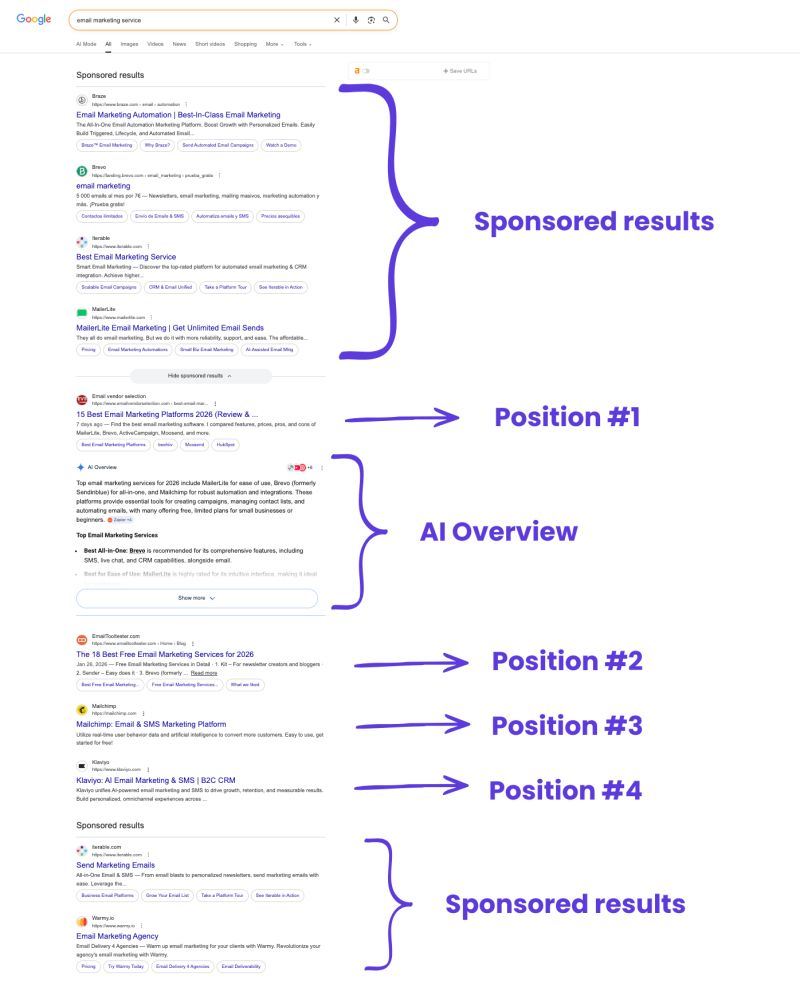
The second major force reshaping the SERP is paid re-monetization. Between January 2025 and early 2026, text ads gained 7 to 13 percentage points of click share across multiple industries, while classic organic results lost visibility. Basically, Google is selling more of the page to advertisers.
Source: Irina Maltseva’s LinkedIn
These two problems need different fixes:
- Zero-click behavior from AI Overviews is a content problem.
- Losing clicks to paid listings is a commercial strategy problem.
Say your traffic is down 18% year-over-year. The instinct is to blame AI Overview cannibalization. But when you pull the SERP data, half the decline is happening on commercial-intent keywords where ads have taken over the top three positions. This tells you that your content hasn't gotten worse. The SERP just looks different now.
Remember, always diagnose before you optimize. Traffic declines rarely have one cause.
Traffic alone no longer defines SEO success
The traditional SEO success story had a clean logic:
Rank higher → get more clicks → drive more traffic → grow the business.
This chain is broken now. Visibility and traffic have decoupled. It is still the right SEO foundation, but the measurement layer on top of it is just more complex now.
Consider two scenarios. In the first, your article ranks #1 for "what is net revenue retention" and owns the featured snippet. Google pulls your definition and you rank in AI Overviews. Thousands of SaaS marketers read your explanation every month and associate that answer with your brand. Your GSC impressions are strong. Your traffic from that keyword? Flat, because most users got what they needed on the SERP.
In the second scenario, you rank #4 for the same keyword. No snippet, no AI Overview mention. You get some clicks, but your brand isn't the one people associate with the authoritative answer.
Which is better for your business? Almost certainly the first, but only the second shows up positively in a traffic-first report.
This visibility-without-clicks dynamic is well-documented. AI Overviews reduce click-through rates by 18-64% on informational queries, yet being cited in them builds brand authority in ways that never register in GA4. Your dashboard flatlines while your brand equity compounds.
SEO performance has to be evaluated more holistically, which means expanding what you measure.
The 5 metrics that actually measure SEO success today
Here's the framework I use. Five metrics that together give you a real picture of SEO performance.
1. Search visibility metrics
Start here. Before anything else: are you showing up?
- Impressions and average position (Google Search Console): GSC is still the most direct window into how often Google is surfacing your content. Impressions growing while clicks stay flat is a zero-click signal, not a problem.
- Snippet ownership rate: What percentage of your target keywords trigger a featured snippet or PAA box that you own? This is a manual audit, but worth tracking quarterly.
Share of voice: The percentage of total SERP real estate your domain controls across a topic cluster. SpyFu's competitor analysis makes this practical. You can benchmark your visibility against competitors across a keyword set and spot where you're losing ground to either organic rivals or paid ads.
Mapping that out across an entire topic cluster is something we do at Seen as a baseline audit. More often than not, you'll find a few obvious gaps you can fix pretty quickly.
2. Brand authority signals
Zero-click exposure builds brand familiarity. These metrics help you see if it's working.
- Branded search volume trend: Are more people searching for you by name over time? Rising branded search is often a downstream effect of strong SERP presence; people see your brand in snippets and Overviews, then search for you directly later.
- Direct traffic trend: A corroborating signal. When people remember a brand from a SERP interaction and navigate directly, that shows up as direct traffic. This is the metric most SEO teams never connect back to their content.
- Backlinks, citations, and media mentions: Increasing third-party references to your brand are another indicator that your topical authority is growing beyond what organic sessions capture.
3. Content citation in AI search
This is the newest metric category, but it’s very important to pay attention to this now. 76.1% of URLs cited in AI Overviews also rank in the top 10 of Google search results, so strong traditional SEO is still the best foundation for AI visibility. But citation tracking adds a layer on top.
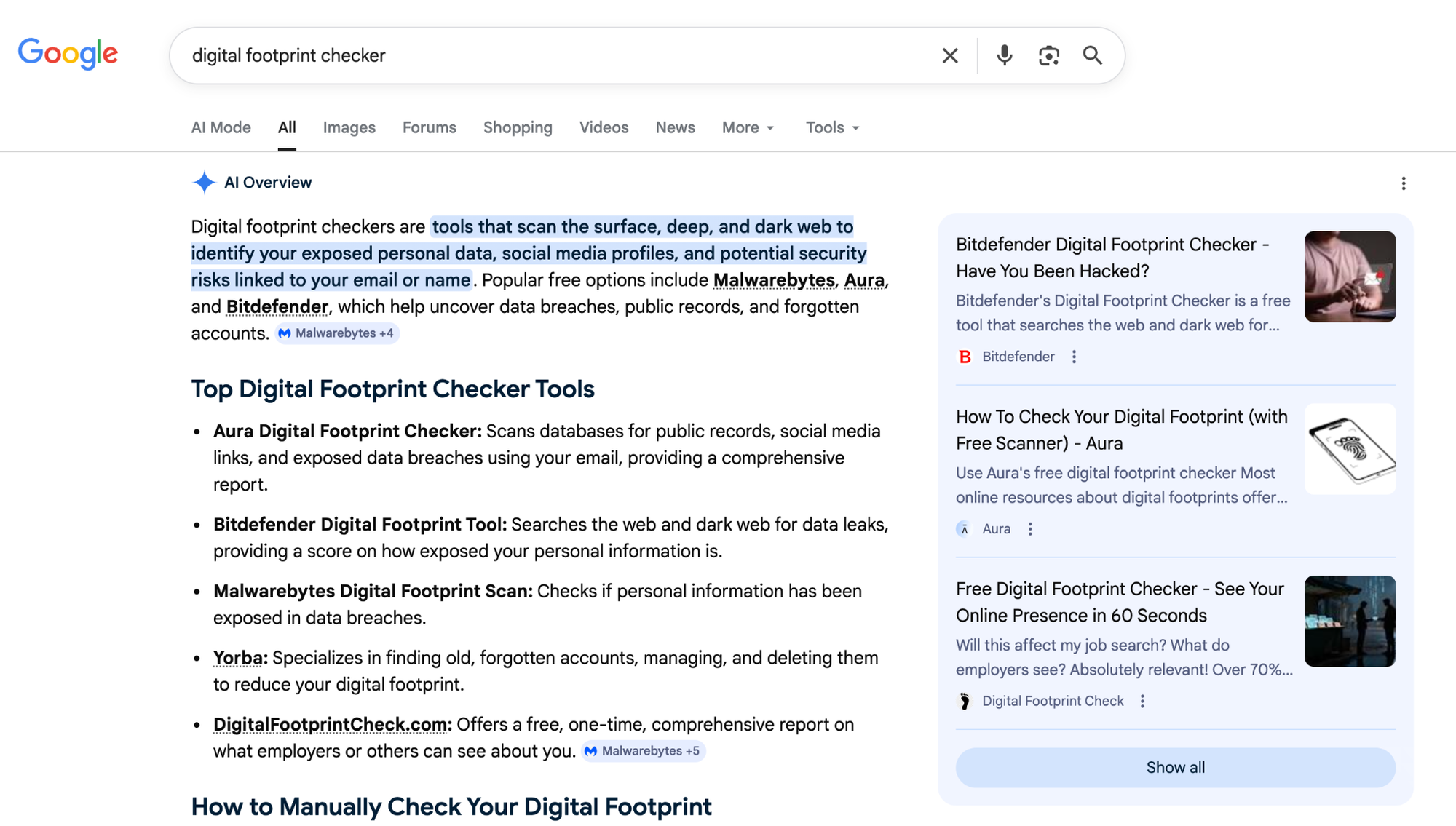
- AI Overview citation rate: Are you being cited in Google's AI Overviews for your target queries? You can check this manually for priority keywords. Take this "digital footprint checker" page as an example below. The query triggers an AI Overview that pulls Aura's page as a source. That's the double win you're optimizing for: show up in the rankings and get cited in the answer.
- Third-party AI citations: Are you being referenced in Perplexity or ChatGPT answers? Tools like SpyFu have the feature to specifically track this.
I'd flag this as a 'watch this space' metric. The infrastructure for measuring AI citation is still catching up to the reality of AI search. But the brands building processes for it now will have a real advantage in 12 months.
4. Assisted conversion signals
Organic search shapes buying decisions long before someone converts. In a zero-click world, that influence starts earlier than ever. Traffic-only reporting misses the whole middle of the funnel.
- SEO-assisted conversions (GA4): Build a custom funnel that counts conversions where organic search appeared at any point in the journey, not just as the last touch. This is where the real SEO ROI lives.
- Time-lag analysis: In zero-click environments, the path from SERP exposure to conversion is longer. A user reads your snippet in January, remembers your brand in March, searches for you directly, and converts. Multi-touch attribution captures that; last-click doesn't.
Just imagine that your organic traffic has been flat for two quarters, and your exec team is ready to cut the SEO budget. But when you set up SEO-assisted conversions in GA4, you find that 34% of won deals touched organic search somewhere in the journey, including several from content that drove almost no direct traffic because it lived primarily as a featured snippet. The SEO was working; you just need to build the right reporting to show it.
This is especially true in long-cycle industries where the gap between a prospect’s first SERP interaction and their eventual conversion can stretch across weeks. In these cases, ignoring multi-touch journeys can significantly undervalue the true contribution of organic search, especially in complex buying environments such as lead generation in insurance, B2B SaaS, or enterprise software.
5. Keyword footprint and topic coverage
Individual keyword rankings are a rearview mirror. Topic coverage tells you where you're going.
- Cluster coverage rate: For each topic cluster you're targeting, what percentage of the related keyword set does your domain rank for? Gaps in coverage are gaps in authority.
- Topical depth: Both AI engines and Google's ranking algorithms favor sources that cover a topic comprehensively. Breadth and depth of coverage across a subject area is increasingly a visibility driver, not just individual page optimization.
How to report zero-click performance to stakeholders
The hardest part of zero-click SEO isn't the strategy. It's actually the meeting after.
Explaining to a CMO or founder why traffic is down but SEO is working is a genuinely difficult conversation. If you get it wrong, you’ll lose budget. But if you get it right, you shift how the whole channel is valued.
1. Reframe the conversation around visibility
Most executives equate SEO with traffic because that's how it's always been reported to them. Before you present a single number, you need to shift the frame.
A simple one-liner works well here:
"Search behavior has changed. More than half of Google searches now end without a click, so traffic is no longer the full picture of our search presence." It sounds simple, but framing it this way before the data comes up means leadership interprets the numbers differently.
The goal is to shift from traffic to visibility and influence: how often your brand is appearing in search, and how that presence contributes to the user journey even when nobody clicks.
2. Build a visibility scorecard for monthly reporting
Start with a quick SEO audit of your current organic performance to set the baseline, then replace the single traffic graph with a short scorecard that captures the full picture:
- Impressions (GSC): How many times did we appear in search?
- Snippet/feature ownership: What % of target keywords trigger a SERP feature we own?
- Branded search volume: Is more people searching for us by name (Google Trends or GSC branded queries)?
- SEO-assisted conversions: How many converting users touched organic search at some point?
- Organic traffic: Still included, but as one data point among five and not the headline.
This is just a different arrangement of data you mostly already have. The scorecard format also makes it much easier to tell a coherent story rather than defending a single declining number.
3. Use a simple narrative when presenting results
Reporting raw metrics may cause confusion, so try framing monthly SEO updates like this:
"We appeared in Google X times this month. We owned X% of the answer boxes across our core topics. Of the customers who converted this month, X% touched organic search somewhere in their journey."
Only three sentences and three numbers, but it shows the complete story. You can copy that template directly.
4. Address the "but traffic is down" question directly
Don't wait for it to come up. Address it first.
When traffic declines come up, there are three steps worth running through here. First, provide industry context: organic CTRs are declining across the board because of SERP changes, not just on your site. Second, show the SERP composition shift: use SpyFu or GSC data to show whether the decline is from AI Overviews, more ads, or something else. Third, pivot to what's growing: impressions, branded search, and assisted conversions.
The goal is to give leadership an accurate picture of what declining traffic actually means today, and what it doesn't.
Start measuring SEO the way search actually works
The scoreboard has changed. SEO used to be a one-metric sport. If traffic’s up, good; traffic down, panic. Now it's five metrics, and honestly, they tell a much better story.
The fix isn't complicated. Audit your current reporting. Are you tracking impressions alongside traffic? Do you have SEO-assisted conversions set up in GA4? Are you watching branded search volume? If not, those three come first before you touch a single piece of content.
And if you want to see how your visibility stacks up against competitors across both organic and paid, SpyFu's share-of-voice and SERP analysis tools are worth bookmarking. Because in a world where the SERP itself is the product, knowing who owns what real estate matters as much as where you rank.
