Google has been steadily automating Search campaigns for years, and the September 2026 AI Max migration may be the biggest shift yet. The biggest question isn’t whether automation can improve performance. It’s how much visibility advertisers lose in the process.
Campaigns will still run. Performance might even improve. But the way you understand why something worked (or didn't) changes quite a bit.
Let’s walk through what’s actually happening with AI Max, and what you should consider before making the move.
What AI Max is actually doing differently
With traditional Search campaigns, you were mostly telling Google which searches to target.
AI Max works more like this: you give Google your website, your conversion goals, and some guidance about the kinds of customers you want. The system then decides which searches are relevant, what ad variation to show, and sometimes even which landing page fits best.
You still have controls. Keywords, negatives, and exclusions still matter. But you’re no longer managing every query directly the way you would in a more manual campaign structure.
That’s not entirely new. DSA (Dynamic Search Ads) already did some of this. But now, AI Max is ramping that up in so many directions that it's tough to credit success to the right combination.
With DSA, you could still trace things back. You could see enough of the queries to understand patterns. You could shape the campaign with negatives and structure in a way that felt predictable.
With AI Max, those same decisions still happen—but more of them happen outside of what you can directly inspect.
And considering that privacy issues keep Google from showing you many long-tail searches, you're going to see a lot more of those hidden "other" entries in your analytics.
Google has added some controls back in (brand exclusions, URL rules, reporting dimensions), but they don’t bring you back to the same level of visibility. Let's put it this way: it's more like being on a ride with guardrails than having the actual steering wheel.
What happens if you opt out—or don’t
This is a practical question, especially with so many changes planned.
If you opt out, your campaigns will remain query-based, and you will need to assign match types and assets like headlines, ad copy, and the right landing page. That can be useful if you want time to benchmark or clean things up before making a change.
However, if you're relying on tools like DSA, you won't have access to those anymore. So I can't necessarily say that your "opt out" status will be exactly as it is today.
If you don’t opt out, your DSA campaigns are automatically migrated. Matching becomes keywordless, ad creation becomes automated, and landing pages can be selected dynamically.
However, there's a bit of a hybrid that Tree Fine, our in-house Google Ads specialist, is trying.
His plan is to keep the "Optimize your campaign with AI Max" setting on, but he'll uncheck the specific Text Customization and Final URL Expansion options.
"That way it has control over some things, but I don't want it to actually mess with our ad creative or send it to pages that I'm not aware of."
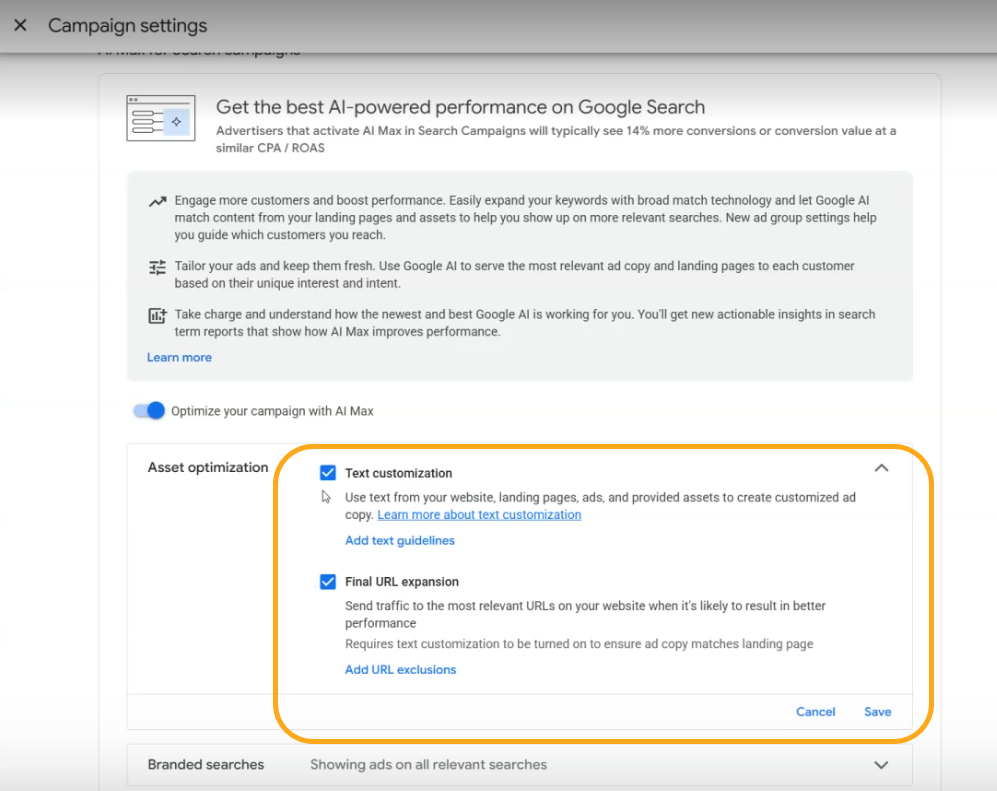
One important note is that DSA is being phased out altogether, so there's no option to stay on today's version of DSA while opting out of AI Max. You can rebuild campaigns manually, but you won’t be restoring the original system.
If you do move forward with AI Max, you still have control—but it looks different. You’re setting budgets, signals, and constraints. You’re not choosing every query or writing every ad variation yourself.
I know I might be coming off as a bit too cautionary about AI Max, and I'm not trying to equate it with doom. Instead, consider some valid concerns to get ahead of before you make the switch.
Some Google Ads Managers are voicing concerns
We've all been through big shifts and roll-outs. Google has been moving advertisers toward more automation for years now. This one, though, is making deeper cuts into a pretty key part of campaign management.
Most of the friction here comes down to bigger loss of visibility into "what exactly got me those results?"
Google has been limiting search term data for a while now, so the idea of incomplete reporting isn’t new. (Has it been 5 years already since we talked about workarounds for lost data?) What’s new is how much of the campaign depends on decisions you can’t fully trace.
There are a few places where that shows up right away.
One is query expansion. AI Max will have your campaign matching queries that go well beyond what you would have targeted yourself, and a large portion of that long tail never makes it into your reports.
Another is ad copy. The system generates variations dynamically, but you only see what was served. You don’t see what was tested and discarded, which makes it harder to learn from the process.
Landing pages are similar. With Final URL Expansion turned on, traffic can be routed to pages you didn’t specify. You can exclude pages after the fact, but the selection logic isn’t something you can review directly.
And then there’s the mix between brand and non-brand traffic. AI Max doesn’t respect campaign boundaries in the same way a manual setup would, so you can end up with branded queries influencing performance in ways that aren’t obvious from the reporting.
For example, a campaign that's meant to target broader searches like “project management software” might start appearing for searches like “Asana alternative” or even your own branded terms because the system sees strong conversion intent there.
That can make performance reporting harder to interpret. Your branded terms most likely convert at a higher rate. A jump in conversion rate may reflect more branded traffic entering the campaign—not necessarily better generic targeting.
See how that can be misleading?
You will be working with a partial view of what’s happening.
Missing context could add up into bigger challenges
This is where most advertisers start asking the same question: “How do I know what the campaign is actually doing?”
Inside Google Ads, you’ll know just part of it.
You’ll see performance trends. You’ll see some queries. You’ll see the outcomes. What you won’t see is the full combination of elements that got you there: the right headline and ad copy combination on that certain keyword.
Sure, this doesn’t behave like a true black box, but it doesn’t feel transparent either. A better way to think about it is that you’re looking through a layer that filters out a lot of the detail.
How people are filling that gap
The way most experienced PPC teams handle this is by stepping outside of their own account data and looking at the SERP results that actually came together.
- If AI Max is matching new queries, those queries don’t have to be hidden away entirely. They show up anywhere advertisers are competing.
- If it’s generating new ad variations, those variations are visible when they actually run.
- If it’s favoring certain landing pages, you can see which pages consistently appear in ads across your category.
That’s where SpyFu helps with a different look at the ad results.
It doesn’t try to interpret what Google’s system is doing internally. It shows you what actually made it onto the search results page—keywords, ads, and landing pages across competitors.
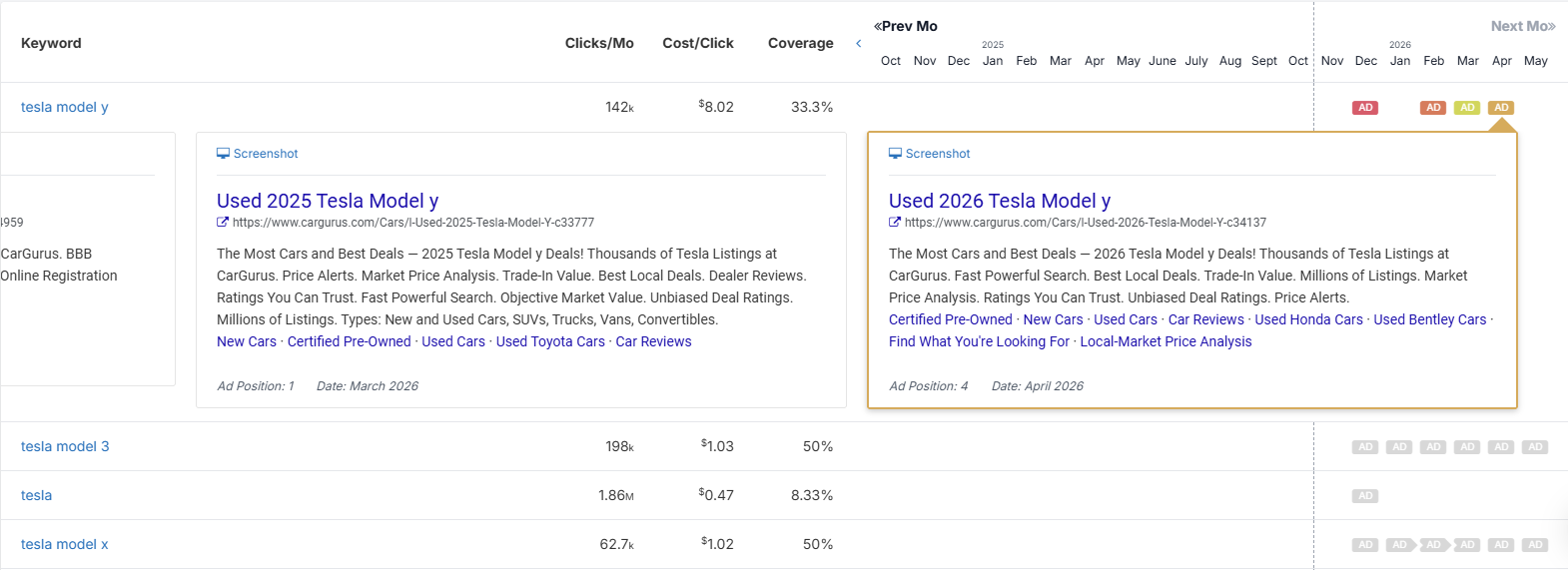
That distinction matters more with AI Max than it did with DSA. When your own reporting is partial, observing the auction becomes more useful.
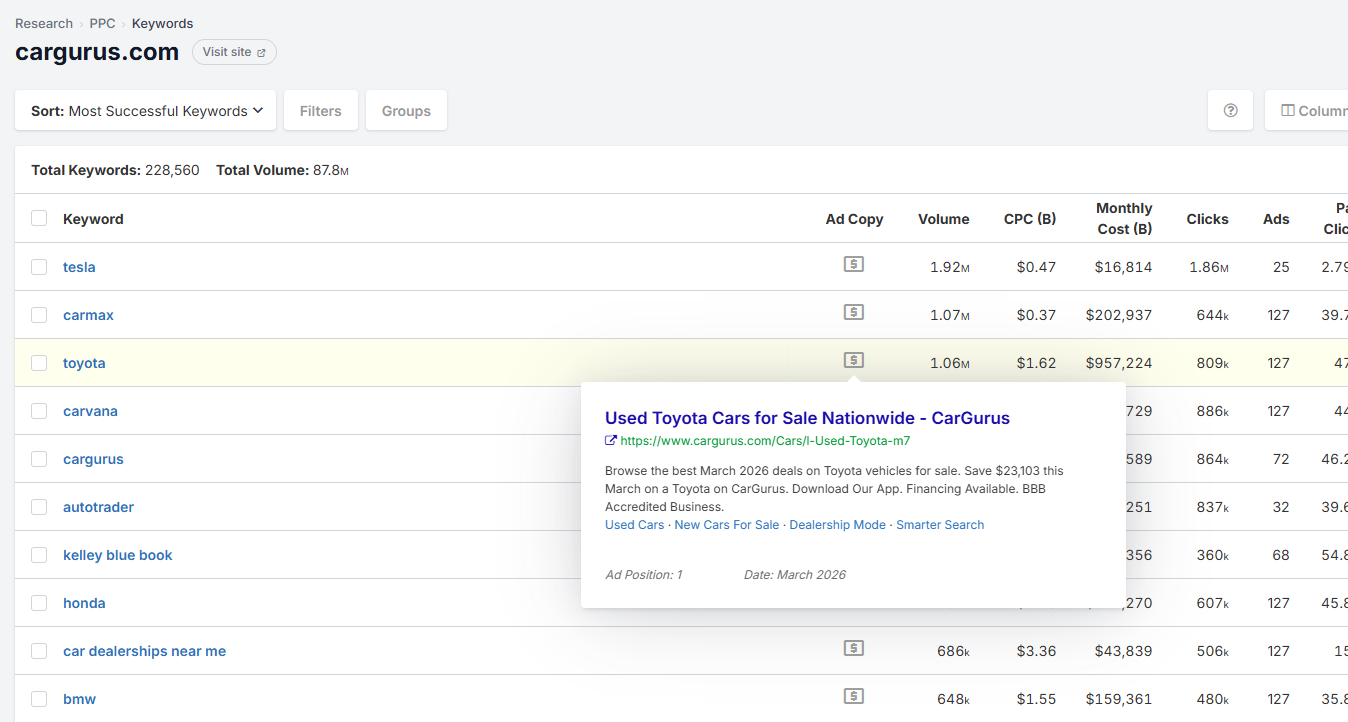
Even a quick domain search lists the keywords we spotted for a domain, so you can see the ad combinations that landed on the SERP.
What the early performance data actually says
If you’ve been trying to decide whether to lean into AI Max or hold off, the independent data isn’t giving a simple answer.
Across a sample of 250+ campaigns, the median outcome was higher revenue--about 13%. However, that came with a rise in cost per acquisition, too--around 16%. That doesn't mean that all of those campaigns reacted the same way to AI Max changes. The spread was wide enough that some accounts saw strong gains and others moved in the opposite direction.
The takeaway most people have settled on is that outcomes vary based on how strong your inputs are: conversion data, site quality, structure, and signals.
That lines up with what you’d expect. When more decisions move into the system, the quality of what you feed it matters more.
What to do before the migration
You don’t need to rebuild your campaigns before September. But it helps to have a clear baseline.
Look at a few of your closest competitors and pull their paid keywords, ads, and landing pages. That gives you a working view of the queries and messaging that are actually active in your space.
At the same time, capture your own current performance—especially your mix between brand and non-brand traffic. Once AI Max takes over, that separation can get harder to read.
This isn’t about trying to outsmart the system. It’s about having enough context to recognize what changed after the migration.
The shift underneath all of this
AI Max is changing the role you play in managing campaigns, and there's far less direct control. Put another way, there's far less angst about choices and worrying what to test.
It’s moving toward something else: setting constraints, feeding better signals, and evaluating what the system did with them.
And if that feels a bit uncomfortable, it might be because Google is asking you to trust more of the process even though you're still on the hook for the campaigns to succeed.
AI Max doesn’t remove that responsibility. And in that new system, having a way to see what’s happening beyond your own account becomes less of a nice-to-have and more of a requirement.
Google has been steadily moving advertisers toward more automated campaign management for years. AI Max is simply the most aggressive version of that shift so far. If you want a broader look at how automation is changing Google Ads workflows overall, this breakdown of Google Ads automations is helpful background.
